

Big Boys Do Cry! Sometimes...
Is crying the gold standard for emotional health?

Society oppresses boys and men when it comes to emotional expression. Isn’t it time we started to question these old gender stereotypes? Culturally perpetuated myths like “Boys Don’t Cry” can seriously affect boys’ future well-being. In a world full of judgment and superficial definitions of strength, boys need to learn that it is OK to cry. Eleni Vardaki
**
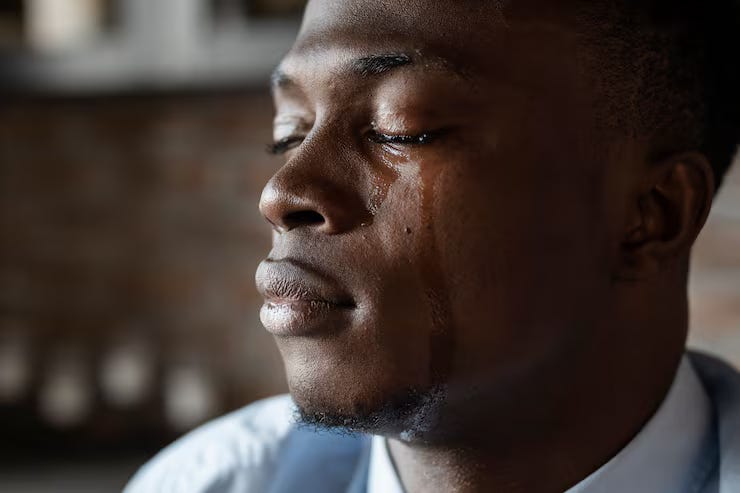
I’m a man. A 68-year-old man. And I’ve cried a lot lately. A. LOT! I have cried every single day for the last eight weeks since Jan died. And I’m not done.
I’m not one who’s been afraid of tears. In fact, for as emotive as my wife was, I think I cried more than she did.
Some movies make me cry. As do emotional sports victories in Arizona (which are so few I think it happened once or twice!) Sometimes I’ll see a person and something about them moves me to weep for them.
That’s not to say that I cry often or even a lot. But I do cry (and I’m a left-brained guy!).
I don’t think I’m an anomaly.
Men cry. Some more than others.
But crying isn’t the point.
Expressing emotion in healthy ways is.
And the biological reality is that men tend… tend… to emote differently than do women.
That doesn’t make one better than the other. Nor are tears the sign of emotional health.
Disclaimer… I’m not a brain-scientist or a psychologist or a psychiatrist or a therapist, so I’m not an expert on how emotions work. But I do live close to a Holiday Inn Express.
Actually, I’ve spent the last 20 years of my life working with Dr. Michael Gurian looking at how men and women tend to be wired differently… from the brain to hormones… and how that impacts how we emote.
So here are some of what I think might be helpful insights as we lead our boys—and even our girls—into emotional health.
I want to use the article written by Eleni Varaki, quoted above, as she makes some very good points, but, as is always the case with emotions, the brain, and biology, need some nuance:
Point 1—Eleni Varaki: Girls have tear ducts. Boys have tear ducts. We ALL have tear ducts.
I don’t know any man who doesn’t cry when he’s cutting a bunch of purples onions. You know, the kind that make your eyes sting when you cut them.
There is a biological reason for why we all have tear ducts. Biologically, we all have the same ability to cry when we are feeling stressed, sad, angry, grief or happiness.
The belief that “boys don’t cry” goes against biology.
My response: Yes. But…
Several factors play a role in an individual’s propensity to cry. Gender differences in crying, for example, have been explored for decades and across the world, and all of the studies reached the same conclusion: Women cry more than men.
In the 1980s, biochemist William H. Frey, PhD, found that women cry an average of 5.3 times a month, while men cry an average of 1.3 times per month, with crying defined as anything from moist eyes to full-on sobbing. Those averages still appear to be about the same, suggests newer research, including work by Lauren Bylsma, PhD, of the University of Pittsburgh (Journal of Research in Personality, 2011).
Biologically, there may be a reason women cry more than men: Testosterone may inhibit crying, while the hormone prolactin (seen in higher levels in women) may promote it. (American Psychological Association)
And this: Males generally have larger and deeper tear ducts (nasolacrimal ducts) and larger tear gland cells. This larger “drain pipe” allows tears to clear into the nasal cavity more quickly when tearing up.
Females generally have shallower and shorter tear ducts. Because their drainage capacity is smaller, their eyes’ “banks” are more likely to burst, causing tears to spill over the eyelids faster.
My point: crying is not the be all end all of emotional health. It is a tool, and a great one. But emotional health is the key here, not crying. And holding up crying as the gold standard of emotional health, or the cure for bad masculinity, is harmful to boys and is bad science.
Point 2—EV: I am a teacher. And from the perspective of a teacher, what I see (which concerns me) is that despite having entered the 21st century, many of us are continuing to teach our boys the unhelpful, unhealthy belief that “Boys don’t cry”.
Did you know that men are more likely to commit suicide than women, globally?
Could there be a link between the damaging beliefs we teach little boys and men feeling shame and fear at being seen as weak during financial and emotional crises?
My response: There are many reasons for why males die by suicide, but the antidote is not getting them to cry more.
Males are isolated… many males are feeling devalued… mental illness is certainly the main reason. And this is where a focus on emotional health needs to take priority… not by getting boys to cry more, but by getting them to understand how they, as males, best emote.
The male brain does not connect words and emotions, generally speaking, the way a female brain does. It can take minutes to hours for a male to answer the question: How are you feeling?
Males are not typically verbal emotive.
Males tend to express emotion through action—hitting something (a ball, a pillow), moving (going for a walk or run), or even through drawing or building something.
Boys can talk about their emotions. But usually they have to be moving to help their brains engage. A walk with mom or dad, for example, can help the boy open up when the parents see behavior (anger flare ups, isolation, apathy) that concerns them.
Again, crying is good. It’s been a great release valve for my grief. But my tears aren’t the heart of soul of my emotional health at this point. I have other areas to watch, live out, and act on.
And when boys cry, or if your son/grandson cries freely, fantastic. But make sure you’re helping him build healthy ways to deal with that emotion in addition to crying.
**
In writing my Toby Baxter series, that kind of brain-science stands behind the story. I am trying to create a male character who emotes, but emotes as a male. He does cry. He gets angry. He gets frustrated. He experiences joy. But he sometimes needs the guidance of others to help his brain process the emotion. My hope is that Toby can serve as a fictional model for what emotional health looks like without kids thinking they’re reading a book about emotional health! :)
21 1/2 years since Linda died. That is when I really learned to cry, show my emotions, all of it. Thanks for this article.